Three weeks ago we had a discussion about Ajax support in Django, which resulted in "Ajax and Django" wiki page. A short recap: it lists a vague goal, some general considerations, and possible strategies; it scratches the surface of existing implementations (mostly RoR), existing third-party toolkits (Mochikit/Dojo), and related RPC-style and REST-style services. No code was produced, no consensus was reached, but now it is a part of Django’s Version One roadmap.
I just released a refresher for OpenWrt WebUI alpha package. It fixes a bug, which was reported by several people.
Some users had problems with Net configurator applet, if wl0_country_code was unset in NVRAM. While it is extremely easy to set, I suggest reinstalling webui. Please read the original post on how to do it.
Thank you guys for your great feedback! Working together we will make webui even better.
It is practically impossible to travel to Muslim countries without hearing some anecdotes about Nasreddin Hodja. Here is one (the source):
Hodja was once a judge. One day a man came to his house to complain about his neighbor. Hodja listened carefully and then said to him,
— My good man, you are right.
The man went away happily. In a little while the first man’s neighbor came to see Hodja. He complained about the first man. Hodja listened carefully to him, too, and then said,
Finally I released WebUI 0.1 (Homunculus) alpha — AJAX-based web interface for OpenWrt made with Dojo! Highlights of this release: 5 more applets including firewall configurator and more network settings. Now proceed to install the package and to read release notes.
The package is here: webui-0.1-alpha.ipk. You can install it using following command in OpenWrt shell:
ipkg install http://lazutkin.com/download/webui-0.1-alpha.ipk
Release notes:
- WebUI can be installed side-by side with webif (comes standard with OpenWrt White Russian RC4). To access it use following URL: http://your_router/webui.html.
- Five more applets are added to this release:
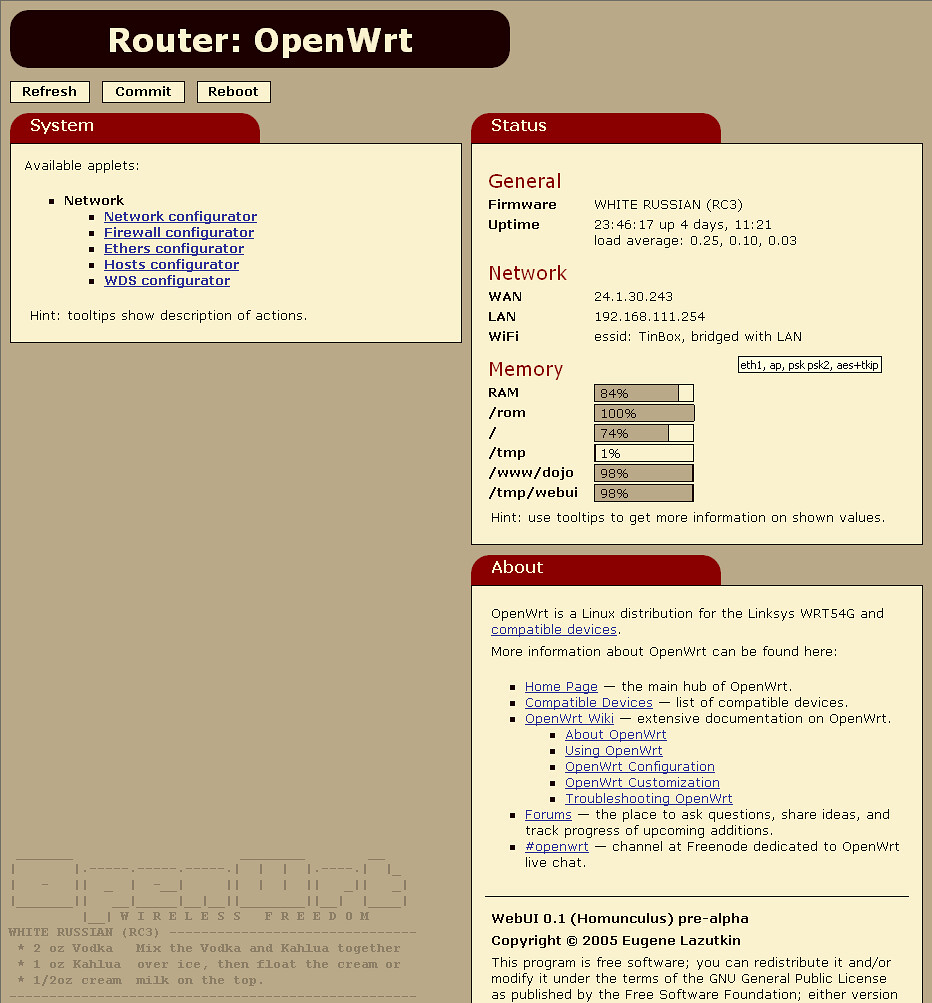
- System: provides a menu for existing applets.
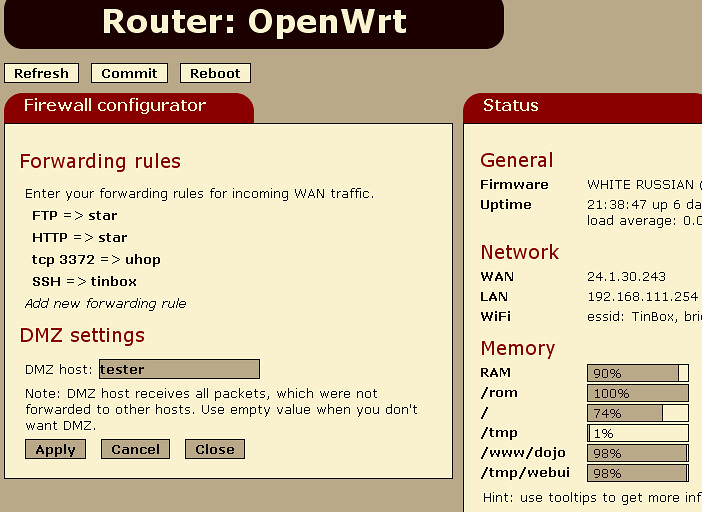
- Firewall configurator: simple management of DMZ and port forwarding.
- Hosts configurator: manages a list of static hosts (used by DNS and by Firewall configurator).
- Ethers configurator: manages a list of static assignment of IP by MACs.
- WDS configurator: manages WDS connection settings.
- General clean up of user interface:
- More information is moved to tooltips.
- Help is provided by tooltips.
- Context-specific references to OpenWrt documentation.
- Tested on following browsers:
- Firefox: works.
- IE6: works.
- Opera 8.50: doesn’t work.
- Konqueror: doesn’t work.
- I decided to proceed with release in spite of Konqueror and Opera problems. I hope it will be solved later. For now use Firefox.
- As always I appreciate your feedback: openwrt [@] lazutkin [.] com.
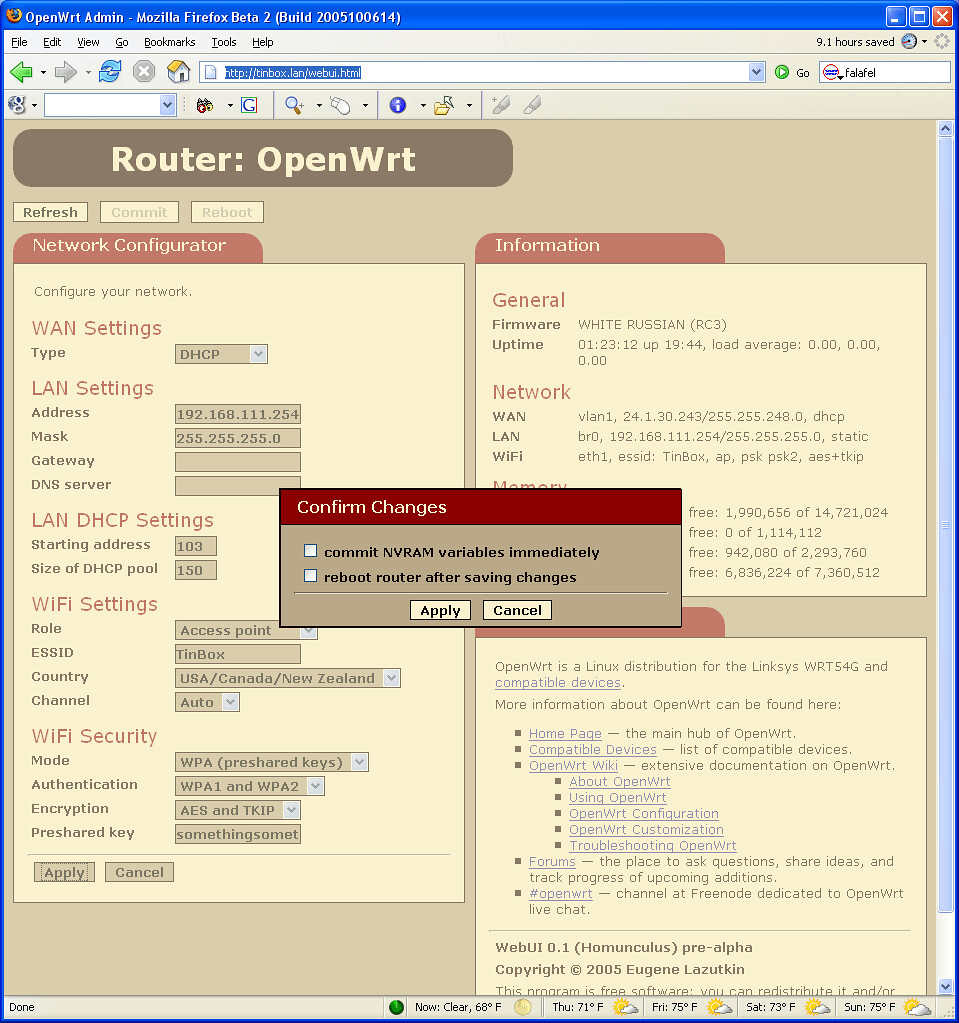
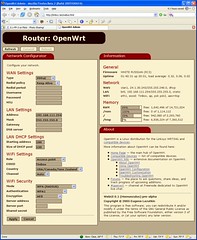
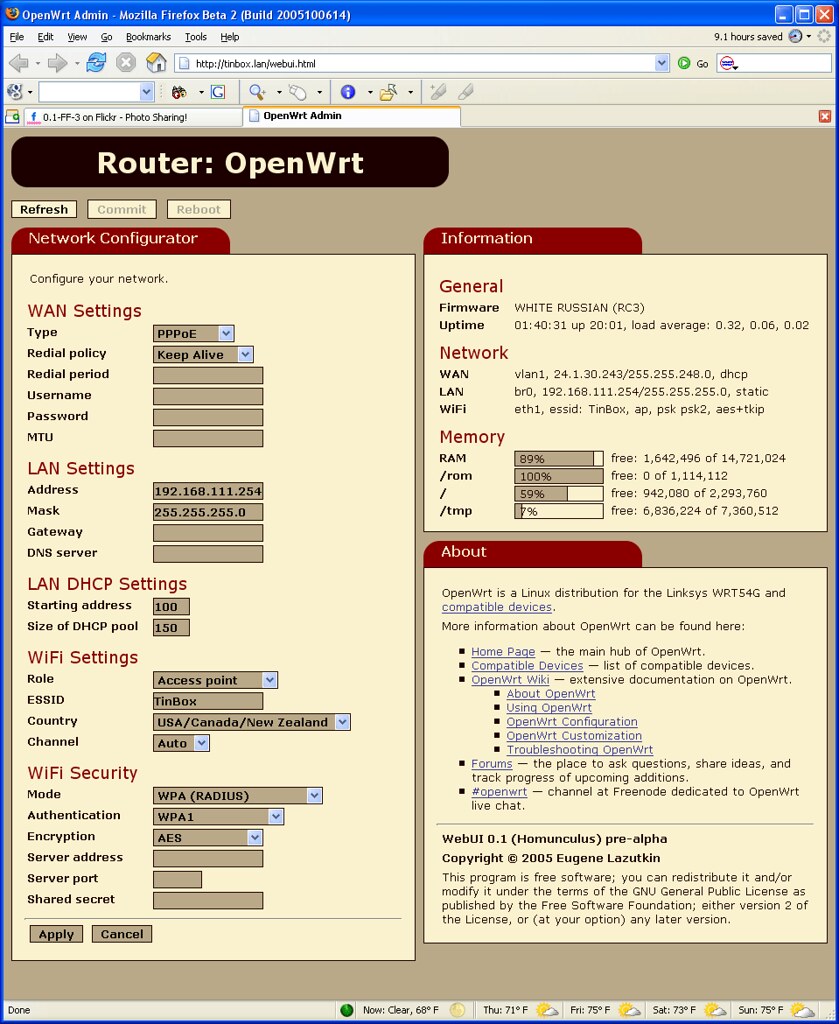
During final tests I found a nasty bug in "Firewall configurator" applet. I decided to postpone the release until I’ll be able fix it. Here is the bastard:
I found a blog post describing London Web Frameworks Night, which took place on 11/17/2005 at the University of Westminster. Jabbering Giraffe reports on presentation of three web frameworks: Catalyst, Django, And Ruby on Rails.
It is an interesting read. Author remarks that Django’s Admin ("with lots of Ajax and JavaScript goodness") was the main object of envy of other frameworks. Another interesting remark was how good Rails people are at marketing.
I was able to work more on OpenWrt GUI. Alpha release seems inevitable now. I’ll try to publish it during this weekend.
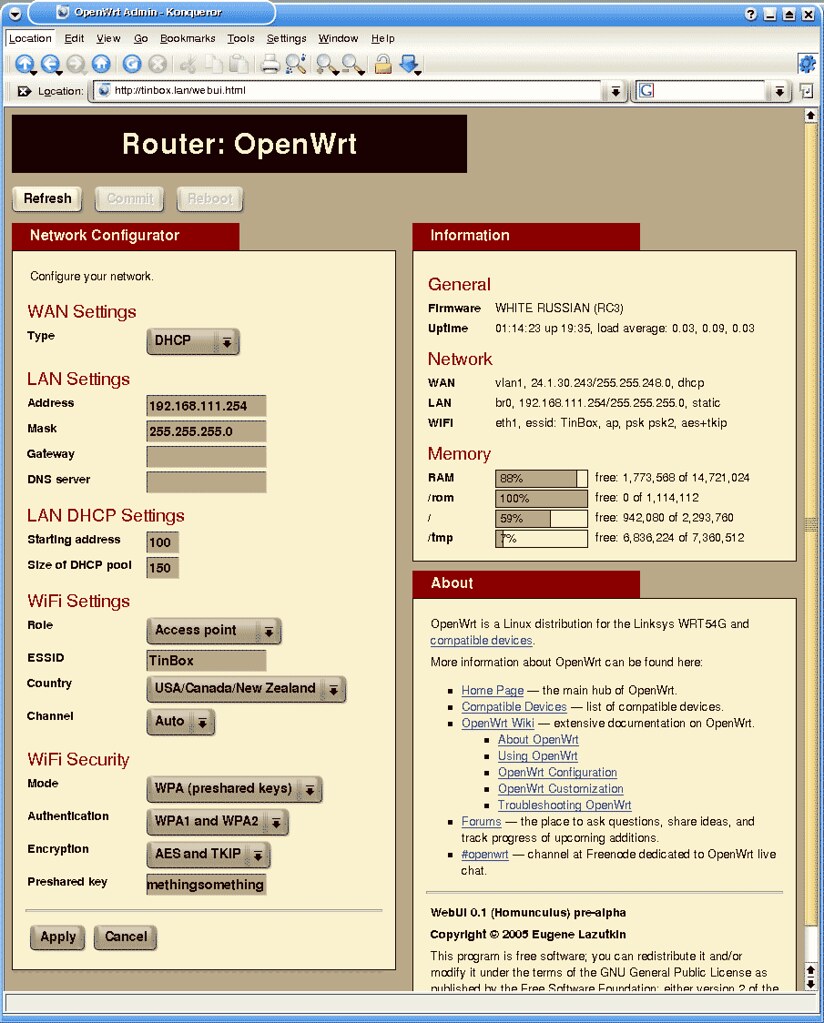
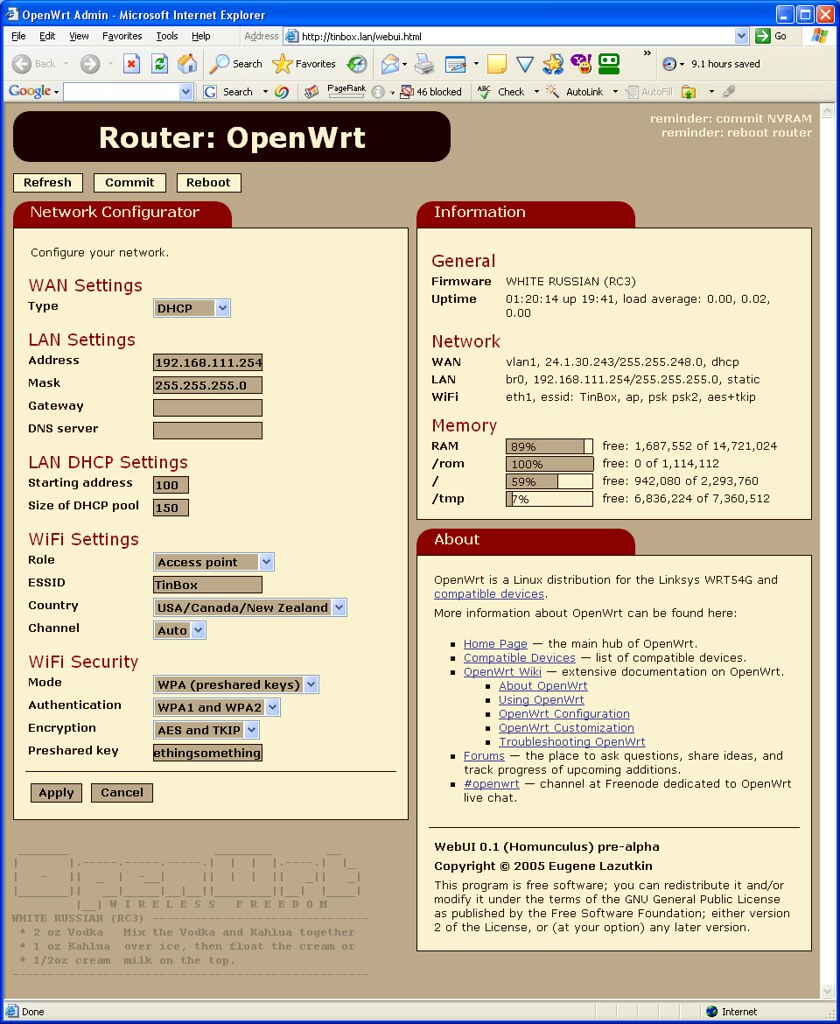
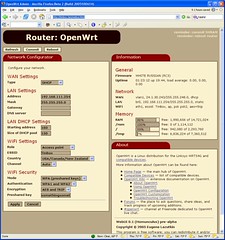
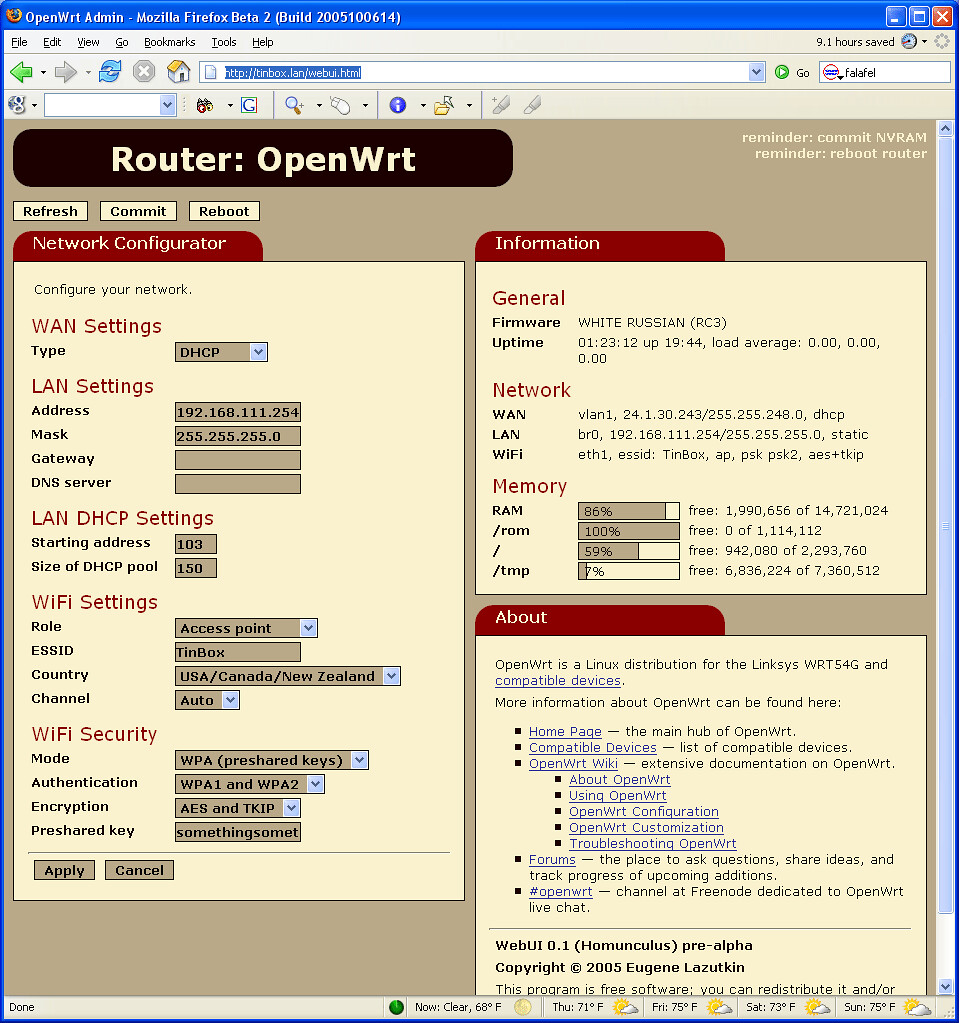
I added back the main applet, which serves as a menu for all other applets. More network configuration-related applets are added. Status applet is cleaned up considerably: all less important information was moved to tooltips. Here is a new screenshot for your viewing pleasure:
Stay tuned for upcoming alpha release!
Last time I visited New Orleans on July 23, 2005 on my way to Florida. It was a short visit. I planned to stop again on my way back, but I didn’t have time. "New Orleans is not going anywhere. I can do it some other time." One month later Hurricane Katrina made landfall devastating New Orleans.
I am looking at pictures I took during that brief stay — everything is so peaceful. It was about noon. Streets were practically empty. Tourists were sleeping late after crazy night on Rue Bourbon.
As you all know Django has new shiny RSS framework. This change breaks my simple RSS tutorial and I am glad that it happened! To tell you the whole truth, it breaks only "The Simple Way" to do RSS in Django replacing it with even simpler one. "The Smart Way" RSS still works as you can see on my web site. Like I predicted the feedgenerator is still around and it learned some new tricks: it can produce Atom feed now! I am going to update the tutorial recreating old examples with new RSS framework. It will be fun!
Recently I looked at the stats of my web site. DreamHost provides Analog 6.0. I supplemented it with awstats. Plus there are some other means to analyze the traffic. Let’s put it this way: I know my average reader. I thought I did. Anyway I found a few surprises.
The country list includes 77 countries. Out of 193. Not bad for a personal blog. Practically all Eurasian countries, and countries of both Americas are in the list. Australia, New Zealand, and many island countries are there as well. Only 2 countries from Africa: South Africa and Senegal. Pity.
As of today i18n branch of Django is merged back to trunk. What is i18n? It is an abbreviation of the big word "internationalization". l10n ("localization") is a sibling of i18n. In practice it means that now you and I can do truly international multi-language web sites without much hassle. While this is more important for big corporations and international organizations, it is a big step for Django’s truly international community. Let’s thank Hugo (the engine behind this effort), all participating developers, and all translators for their monumental effort to make it a reality.
New TinyMCE 2.0RC4 is out. It fixes numerous bugs, which never bit me. Is it going to be the last RC before actual release? Who know. Grab it while it is hot!
I didn’t have a lot of time this weekend. So I decided to implement the simplest part of upcoming OpenWrt GUI (webui) — hosts editor. It is a perfect candidate to write something in 15 minutes or less — it has almost no "business" logic in it: read/edit/verify/write cycle. The hardest part was to learn how to upload dynamically generated files without writing them to disk first.
It turned out to be very simple. Right now it is implemented using Dojo’s versatile dojo.io.bind() facility and some external code.
Update: this document is officially obsolete — alpha is released!
Please download it again: /webui-0.1-pre-alpha.ipk — two debug files made their ways to the release messing things up. Now it is fixed and I hope it’ll work for you.
DreamHost has switched to Python 2.4.1. Now python is the alias for python2.4. Yay!
Update: checked it again — nope, python is the alias for python2.3. But python2.4 is available as well.
Update: this document is officially obsolete — alpha is released!
Finally I released a preview: /webui-0.1-pre-alpha.ipk!
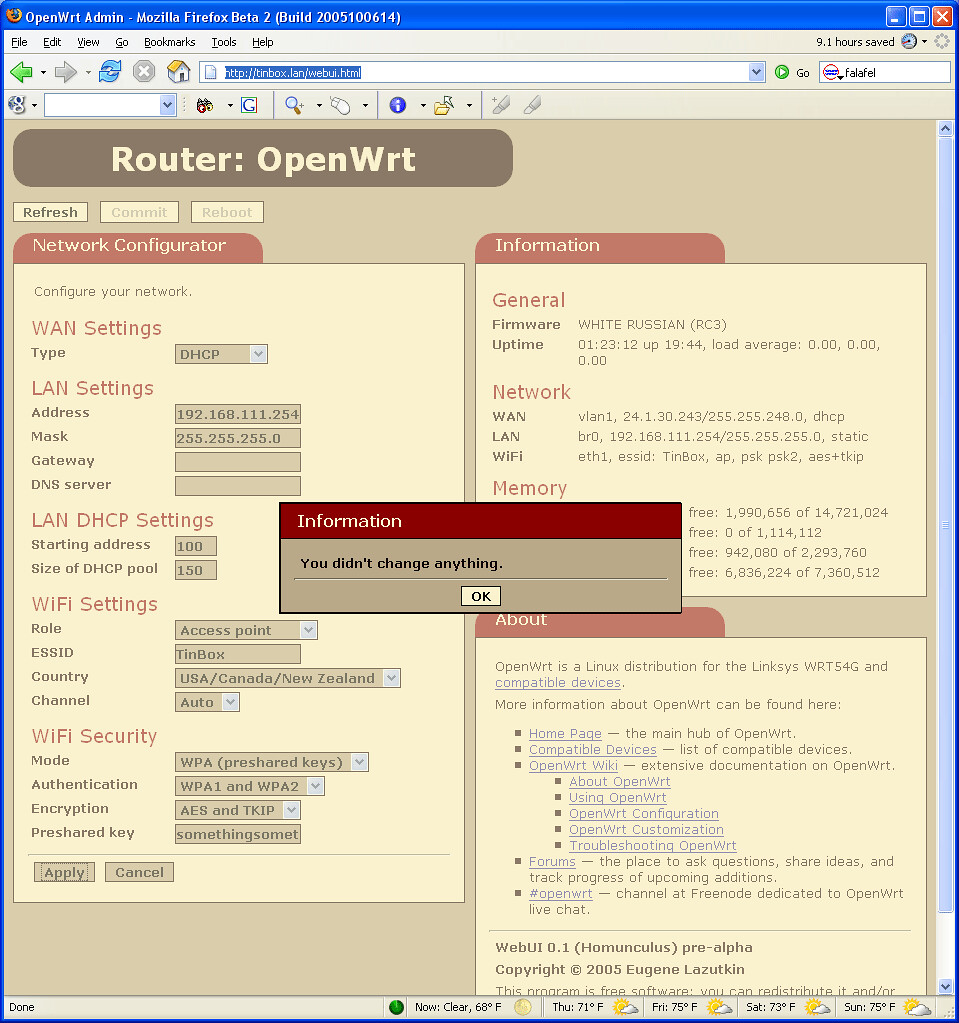
I included two information applets and a simple network configuration applet. I think it would be enough for a proof of concept. I borrowed heavily from nbd’s webif. So if it works for you, it is due to his OpenWrt expertise. If it doesn’t, it is my fault.
Both webif and webui can be installed side by side: