Finally: my open source JavaScript project DCL
is built on ideas described in this article. Available for node.js and modern browsers, it implements OOP with mixins and AOP at "class" and object level. Read documentation and background articles on www.dcljs.org
, clone its code on github.com/uhop/dcl
, and follow @dcl_js
.
Once again I was invited in ClubAjax
to speak about JavaScript. This time I did a presentation based in part on my previous blog post OOP and JS
. Slides and talk revisit OOP, mixins, AOP, chaining, and other related techniques I discussed in my blog. Of course, OOP deficiencies were discussed at length too. I suggest to look at slides and read the blog post - it will give you a better picture.
Finally: my open source JavaScript project DCL
is built on ideas described in this article. Available for node.js and modern browsers, it implements OOP with mixins and AOP at "class" and object level. Read documentation and background articles on www.dcljs.org
, clone its code on github.com/uhop/dcl
, and follow @dcl_js
.
Almost any Java programmer, who starts to study JS groking its OOP facilities and a dynamic nature of JS, thinks that they can be greatly improved and starts its own OOP library/helpers. Majority of them left forgotten when their authors learn more and more details and patterns of JS, yet some grow to fruition and being marketed. This article is dedicated to such people.
Many years ago I decided to replace plain text areas in Django’s Admin with rich text editor, so I can edit HTML on my blog using WYSIWYG. Six (yes, 6) years ago I looked around and selected
TinyMCE
. Over time it turned out that I was forced to upgrade TinyMCE and the link script I had because new browsers continue breaking my rich editor editing. Finally it stopped working again in all modern browsers, and I decided that enough is enough. It is time to replace it. This time I settled on Dojo’s Rich Editor
hosted on Google CDN
— simple, functional, less work to set up.
This month I continued my presentation at ClubAJAX
. Last time
I did a survey of what is available in JavaScript, and concentrated on object-oriented (OOP) and aspect-oriented (AOP) techniques. This time I continued the survey, and talked about functional programming (FP), and domain-specific languages (DSL). And as promised I touched the code generation facilities too.
I suggest to read the first part
before.
Enjoy!
Direct link: Exciting JavaScript - Part II
.
Today at dojo.connect
I did a presentation “RAD CRUD”: rapid development of form-based applications. It continues my other presentation “CRUD with Dojo”
, but it is more in depth, targets Dojo developers, and contains some advanced material.
Direct link: RAD CRUD
.
View more presentations from Eugene Lazutkin
.
I was asked to talk about advanced JavaScript techniques at the last monthly meeting of ClubAJAX
— monthly get-together of Dallas-area JavaScript programmers. Instead I ended up talking about leveraging cool JavaScript features to implement well-known programming techniques and paradigms: OOP
, AOP
, FP
, and so on.
Unfortunately I couldn’t finish in time, so I did a tour of some language features, and talked about OOP and AOP. The rest (I plan to do FP, code generation, and DSL
) will be covered later.
My presentation at ClubAJAX
got off to a rocky start: I was let in the
building 40 minutes after I was supposed to start the presentation.
Everybody waited patiently. Thank you guys! As promised I publish slides along with relevant links (I had to skip most
of planned demos).
Here is my presentation on SlideShare
: CRUD with Dojo
. The original presentation can be seen on Google Docs: CRUD with Dojo
.
Time to time I sync my blog software to the Django trunk and
introduce small enhancements. Some of them visible to my readers,
some of them are just for me. This time after reading Simon Willison
’s post on rev=canonical
I decided to add short URLs to my blog as well. This is a convention
to provide custom short URLs managing the mapping on your own web
site. In my opinion the idea is very cool.
Explaining some dark corners of JavaScript, browsers, or Dojo for the 100th time I realized that I already did it on numerous occasions, and some of my answers are published on public web sites. So I decided to round up the most general ones I posted on StackOverflow
and publish links to them here for a future reference.
JavaScript
This section is for language-specific topics. They can be equally applied in any environment.
As you may know today Google released Friend Connect
. I decided to give it a try. It took about 20 minutes to set up my blog with 4 gadgets: Members, Sign In, Rate/Review, and Wall/Comments. It took about 30 minutes to separate the skin from all these widgets, and set up the Canvas so users can see gadgets in a separate window, if they want to.
Google Friend Connect doesn’t have any server-side components on user’s server — everything is handled by Google. All you have to do is to deploy 2 (two) static HTML files, and add various snippets that can be customized and generated on the Friend Connect’s web site. The resulting snippets are simple, and can be easily understood and restructured.
In the previous post
we explored “array extras” and how they can help us to write concise yet performant and clean code. In this post we take a look at generalizing recursive algorithms with recursion combinators — high-level functions that encapsulate all boilerplate code needed to set up the recursion. These functions were added to dojox.lang.functional and will be officially released with Dojo 1.2.
In general the recursion is a form of iterative problem solving in the same category as loops. There are two major natural sources of recursive algorithms: recursive data
structures (lists, trees, and so on), and recursive definitions
(factorial, Fibonacci numbers, the GCD algorithm, etc.). The
recursion plays a prominent role in the functional programming (FP),
and one of the best articles on this topic is “Recursion Theory and Joy”
by Manfred von Thun
, the creator of Joy
(a purely functional
programming language with Forth-like syntax). Manfred’s article
explains intricacies of recursion including the venerable Y
combinator
, recursion combinators in general, and introduces a practical set of recursion combinators, which will guide us in this post.
Finally: my open source JavaScript project DCL
is built on ideas described in this article. Available for node.js and modern browsers, it implements OOP with mixins and AOP at "class" and object level. Read documentation and background articles on www.dcljs.org
, clone its code on github.com/uhop/dcl
, and follow @dcl_js
.
If we look at the history of computer programming languages, we can see that practically all new programming methodologies were about one thing: taming complexity. The anarchy of earlier days of procedural programming
(example: Fortran) gave way to structured programming
(Pascal), which was refined with modular programming
(Modula), and was reformulated when object-oriented programing
went mainstream (C++, and much later Java). And it stopped there. The focus shifted to different branches of computer programming, namely to functional programming, and, to a lesser degree, logical programming. The only major development in this branch was the rise of aspect-oriented programming
(AOP) paradigm. Let’s take a look at AOP in our favorite language: JavaScript, and how Dojo helps the language with dojox.lang.aspect package.
Yesterday Google announced
its new offering: Google App Engine
. These are my random notes I did yesterday when I studied the new service.
Google didn’t go the same way as Amazon with its AWS
. The former offers a form of shared hosting (think “distributed WebFaction
”), while the latter offers a virtualized environment (think “distributed SliceHost
”). So basically we are talking about more high-level approach to web applications, which is easy even for novices. On the other hand AWS is more flexible and more enterprise-y.
As you all know by now Dojo 1.1 was released in the wild
. You can get a lot of useful links and info from James Burke’s post on Dojo 1.1
, but let me tell you why you should be excited:
- Dojo 1.1 is the first official release, which contains dojox.lang.functional
. It was available in the trunk for awhile, but now you can use it without deploying Dojo courtesy of AOL CDN
. I am psyched about it!
- Improvements in animation, animation helpers for dojox.gfx. A good examples of animation in action is dojo.moj.oe
by Pete Higgins
(internals were detailed in the blog post
, and in the great Dojo Campus article
), an example for dojox.gfx animation is the career test
. Finally we are getting to the point when we create attractive GUI cross-platform without plugins.
- The Dojo API tool
. As you know Dojo is essentially a federation of JavaScript modules. Every module can be a library on its own. Now we have a simple way to navigate them, read developer’s documentation without diving into the source, and understand the API. When comments will be added to it shortly, you can add your own notes, and ask pointed questions. Developers are getting an essential tool to see how their modules are documented, what questions are raised most frequently, and so on. This tool will help us to document Dojo even better. All in all Neil Roberts
and Tom Trenka
did a great job!
- Numerous improvements and bug fixes — this is always good. The API is mainly unchanged, so the migration to Dojo 1.1 should be a no-brainer for most users.
I am pleased to see that social aspects of Dojo are getting attention: the redesigned Dojo web site
, the Dojo API tool
, Dojo Campus
is always fun, Dojo forums
are active, even the Dojo archive
is now easy to navigate!
What makes JavaScript so different from other languages? Is it its
dynamic nature? Its prototype-based funky inheritance? No. The most
unusual thing for newcomers is how JavaScript programs handle the
workflow. The program looks like a bowl of spaghetti. There is no start
or end of the program. What we have here is a bunch of functions, which
are called in response to some external events. In most cases we have
no way to predict the order of these events. And we know that all
callbacks are called from a single thread. Of course we know that it is
not a nature of JavaScript but rather a limitation imposed by a
specific container of JavaScript programs — web browsers. Majority of
JavaScript code is written for browsers and now we have a perception
problem. But let’s dig deeper to understand the problem better.
I just finished the first cut of the dojo.dnd 1.1 technical documentation
. Let me use this post to remind you about the dojox.gfx 1.1 documentation
. I hope I satisfied the curiosity of many developers, but the ultimate proof will be the number of simple questions on Dojo Forum
. Let’s hope it will go down. And don’t forget that the Dojo Book
has a DnD chapter
too.
Both documents are hosted on Google Docs
, and are “live” documents — as soon as I update the document it is updated for you too. I intend to update them on regular basis to track the current version.
Everybody knows that JavaScript is a multi-paradigm language, and it can be used to program functionally. Practically all functional idioms can be used directly: higher-order functions, recursion, closures, and so on. The recent resurgence of Functional Programming (FP) brings functional methodologies in the mainstream. FP fundamentals gave us a lot of powerful idioms: iterative functions, which can replace loops, list processing in general, function manipulations, and many other things, which helps us to keep our code small yet concise, more powerful, and more fun. Let’s take a look at how Dojo helps to leverage the functional paradigm in the Core, and in the extended DojoX package (dojox.lang.functional).
I published first day pictures from PyCon 2007. They are raw, unedited, I didn’t put descriptions yet. You can recognize Django guys, people from multiple Python web frameworks, and, of course, the BDFL with OLPC. But why wait for pictures to be prepped? Dig in while they are raw and fresh:

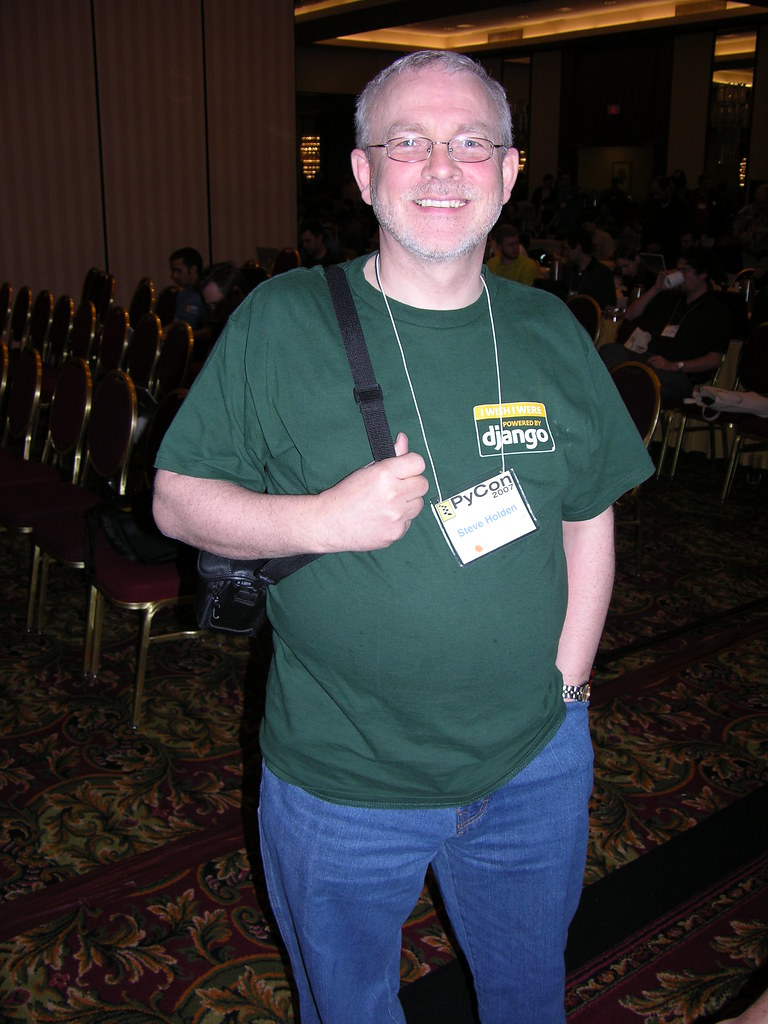
Yes, this is Steve Holden sporting a Django t-shirt.