When linear is not enough
Contents
Every day I get hundreds of emails, several dozen phone calls and text messages, and a dozen paper letters I don’t want. This post is a rant about that overload, and about why the ways we cope with it keep falling behind.

A day of incoming
Spending a minute on each email, listening to each crafted sales pitch or scam attempt, and opening and inspecting every letter would eat my whole day. So I can’t live without spam detection. Most of my email is spam, and only an automated classifier keeps it out of my sight. Practically all my calls go to an automated attendant first, or the whole day would go to answering robocalls.
Is it possible that I miss useful and needed information in all that spam? Yes. Sometimes a legitimate email goes out with the spam. But what can I do?
Cheap to send
Whatever was hard to do back then is fast and cheap now. A letter was written by hand and sent by mail with postage paid, which was slow and costly. Sending a million spam emails today costs next to nothing. The same goes for almost everything else: a robocall, a text message, a comment under a post.
When we started with email, I got one once in a while. Then more, and more. Phone calls were few, and practically all of them were legitimate, apart from an occasional wrong number.
Paper mail shows the other side. Most of what arrives is junk, yet it stays at about a dozen pieces a day, because every piece still costs money to print and deliver. The economics are against it.
Physical things too
Mechanical things are easy to overwhelm as well. Cheap drones used en masse against air defense can overwhelm a sophisticated and expensive system, and defeat it economically too: at some point the defender runs out of expensive missiles.
Or take traffic. Our streets and highways are busy already. What about ten times more cars on them? Impossible, because we don’t have that many people to drive them? But self-driving cars need no drivers. They are pricey now, yet their price will likely go down a lot over time, especially once they are mass-produced. Delivery drones can be abused the same way: just raise their numbers. In a sense, paper spam belongs here too, held back by its cost alone.
We are linear
Technology keeps getting faster and cheaper. People stay the same. We are mostly linear creatures: we handle things one at a time, and each takes its share of our time. Any linear algorithm is easy to overwhelm. Do 100 incoming things a day work? What about ten times more? Still good? What about ten times more again? Anything quadratic or worse is out of the question, and exponential is not worth discussing. We need something logarithmic or better.
Our memory is limited too. George Miller’s 1956 paper, The Magical Number Seven, Plus or Minus Two, put the span of immediate memory at about seven items. Nelson Cowan revisited it in 2001 and found about four chunks, once rehearsal and chunking are controlled for. In Ergonomics and cognitive load I used a looser version, 7±3 core concepts, as a rule of thumb for APIs, wide enough to take in Cowan’s four.
How we cope
User interfaces have well-known ways to make a long list manageable. A paged list of 20 items a page turns item 155 into the 15th item on page 8. Categories split the list by alphabet, geography, type, color, and so on, and a tree or a graph nests them. A filter or autosuggest narrows it by a prefix, a substring, or a word. A full search engine like Google adds ranking, and an AI agent answers a question so we don’t have to read the top results. Each of them cuts down the choices in front of us and makes what is left more relevant. In Miller’s and Cowan’s terms, categories and trees feed our memory bigger chunks.
A spam filter is the same kind of remedy for what arrives, and it has its own arithmetic. Imagine that hundreds of spam emails a day become millions, or billions. Would providers stop accepting email? If a classifier catches 99% of them, does it mean that “only” 10,000,000 emails out of a billion reach the mailbox every day? What about a million calls? The line would be busy all the time. A defense that removes a percentage loses to volume: as the volume grows, the 1% that gets through grows with it.
Quality is the other problem. Spam filters and ad blockers are classifiers that follow well-defined algorithms, rules or statistics. They are mechanical, unlike a person’s judgment, which is hard to codify. Once I debugged a broken website, and it turned out that a programmer had used a script whose file name started with “ad”, something like additional-something.js, though it had nothing to do with ads. That was enough for an overzealous ad blocker to stop its download, which broke the rest of the site. The fix was simple: rename the file, though the copies browsers had already cached made even that messy. Since then I never start a file name, a CSS class, or a DOM id with “ad”. Advertisers can rename their files just as easily, so a rule like that deters little. And what if I want to write about ads: is that an advertisement to block? Then there are ads made to look like something else, such as product placement and infomercials. How do we weed those out? I bet they will become more and more common.
Social networks
Social networks have the same problem. A good, thoughtful post that draws interest collects hundreds of comments. Most of them are about something else entirely, or about the wording, a missing comma, a misspelled name. Fishing the few comments that add something substantial out of that pile is practically impossible.
Then there are the followers. I am constantly followed by fake profiles with attractive photos, engineered to make me think that a supermodel likes me. They hope that I will follow them back, by mistake perhaps, so they can use their subscribers for their proclamations. I check the authors of divisive posts to see whether they are real people or paid bots. That would be fine if such posts were rare, but most of the posts I see are like that, and together they form a distorted informational bubble. With bots on that scale, a social network becomes useless.
Social networks want our time, because time on the site means more ads shown, and interactions keep us there. You, reading this post, will probably chuckle and think: “I thought about it too.” Would you give it a like? Probably not. It didn’t make you rich or much better, and it didn’t open your eyes to the world. My aim was to give you some food for thought. But if I wrote a patently false, divisive, and abusive rant, many people would go out of their way to say that I am wrong, that I am a bad person, and so on. Social networks love that. They would promote the post to invite more abusive interactions and bring in more ad money. A story that resonates, captivating fiction, or a thought-provoking idea is hard to make. A divisive rant is trivial, and it keeps people busy: someone is wrong on the internet, and they have to set it straight.
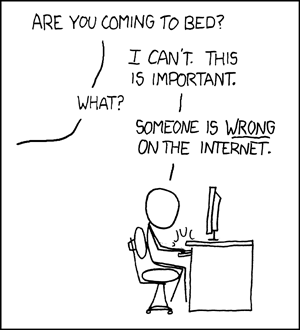
Finding information becomes a chore, with so much fake information, AI slop, and clickbait around it.
We have done this before
We were overwhelmed once already, by newspapers, radio stations, and TV channels. There were far more of them than anyone could consume. The solution was selection: which newspaper to buy, which station to listen to, which channel to watch. We missed a lot, some good content included, yet we managed our flow of information.
Finding the new
Selection has a weak spot: discovery. To look for something, we have to know something about it, at least a name or a concept. How do we discover what is new? That is the job of news and ads. We need reputable news sources, and ads have to be rethought.
Ads were conceived for newspapers, radio, and TV, and they work by repeating their message again, and again, and again. It was a legitimate technique, and it worked in the era before the overload. Now I am not so sure: I think, though I haven’t measured it, that it works less and less well. I can read about a new product, but once I decide that it is not for me, I don’t want to see it again. I haven’t seen a working way to remove it: even when one channel removes it for me, I still get it through others.
A marketing company has claimed that it can target ads by listening to private conversations through the microphones of phones and smart speakers. Besides the privacy violation, a mention can be completely out of context. If I nearly collided with a bike and mentioned it somewhere, it doesn’t mean that I want to buy a bike or have any interest in bikes.
A toast from the 1967 Soviet comedy Kidnapping, Caucasian Style became a Russian saying: “My great grandfather always said: ‘I desire to buy a house, but I don’t have the means to do it. I have the means to purchase a goat, but I don’t desire it.’ So let us drink to our desires always meeting our capabilities.” Ads don’t understand that. Many people want a supercar and cannot afford one. Others can, but prefer to spend their money elsewhere. Or their resources are stretched at the moment: they just bought a yacht.
The amplification our technology gives to ads makes the overload of irrelevant things even worse.
Where this might go
Networks of people again
It is quite possible that social networks will become true social networks again, with only the people we want to connect to, so that we do the choosing again. The same goes for who can reach us by mail, email, phone, messaging, and so on.
Choosing has a danger of its own: an informational bubble of our own making. A newspaper subscription brought a wider view than the slice we wanted. It reported what happened, including things we didn’t like or support. When we pick every source ourselves, our own views come back to us artificially amplified, and our picture of the world gets more distorted. Politics is the obvious case, but technical views can lead to bad decisions too.
Payment as friction
Does someone want to bother us? Let them pay us. The idea is not mine. Proposals to make senders pay for email, in money or in computing time, have been around for years, such as Microsoft Research’s Penny Black project. None of them caught on. The closest was Goodmail: in 2006, AOL and Yahoo let senders pay up to a cent per message to get past their spam filters. Few used it, and Goodmail shut down in 2011. Email still has no postage. A normal person would pay a few cents, if anything, while a mass spammer would have to set aside serious money. Ads would get more expensive too. In effect, the postage is a tax on advertising, and we advertise practically everything, so it would raise the prices of nearly everything without producing anything more. That is inflation, at least until the economy adjusts, which is a long process. Hard to say how much, but it is something to consider.
Paid survey respondents exist already. I even worked for a company that pays them: I was a principal software engineer at Research Now, renamed Dynata during my time there. Businesses pay it for answers from real people, and it pays its panel members in points, miles, or gift cards for their answers and their profiles. It counts more than 70 million members, so paying for attention works at that scale. Even paid attention needs checking, though: Dynata removes respondents it catches cheating or not paying attention.
Personal agents
But how do we extend our circles? Whom do we read or listen to? One way is AI agents acting on our behalf: agents that know our interests and preferences and can suggest whom to follow. Aren’t social platforms doing that already? Nope. They care little about any individual user. I get a lot of bad posts in my timeline, and I am stuck with them. “Train the suggestions with the like and dislike buttons,” we are told. First, I tried it. Second, it is not my job to train social networks, and I have no time for that. Users should be in charge of what they consume.
It is the obvious move in general: give the classification to AI, and deal only with the pieces it has already selected. AI agents as we have them now don’t scale either. They scale differently from people, and I suspect, or at least hope, that their limits are higher, yet they are still limits. We can run more agents, but every message they check costs something, while sending it costs next to nothing: the drones and the missiles again. So I hope for quality more than speed: AI smart enough to guard us, with fewer false positives and fewer false negatives. Then we may have a problem of censorship.
Following a person, not all of their interests
Sometimes I want to follow a person on some of their interests only. You, yes, you, may like to follow me on technical topics and have no interest in this rant. Or you may want to hear from me about Python instead. For that we have tags: this blog has a feed per tag, and an RSS reader can subscribe to one. A feed tailored to each reader’s interests would be better, and tags are a crude approximation of it.
Open ends
All in all, it feels like we are on the verge of clogging every line of communication, and we are not ready. Personal agents representing actual people may be an answer, but that solution raises more questions than it answers. I don’t know the solution, and there are no good ones yet. We should have one, and have it fast, yet we don’t. I hope we will find one.
Summary
- Whatever was slow and costly to send is fast and cheap now, so the volume keeps growing: email, calls, texts, comments, and, as their prices drop, cars and drones.
- People are linear. We handle things one at a time, so any volume we handle today can be multiplied past us.
- Paging, categories, search, and AI answers cut down the choices in front of us. A filter that passes 1% passes more as the volume grows, and its mechanical rules block the wrong things, are easy to get around, and miss ads disguised as content.
- On social networks, substantial voices drown in off-topic replies, follow-bait, and bots. Platforms want our time, and a divisive post, trivial to make, keeps us interacting, so they promote it. Finding information becomes a chore.
- Discovery needs reputable news and rethought ads. Ads that repeat themselves across channels and out of context add to the overload.
- Possible directions: networks of people we choose, at the risk of a bubble of our own making; senders who pay for our attention; and personal agents that do the selection for us. AI has limits of its own, so the hope is better quality more than speed, and it brings a risk of censorship. There is no good solution yet, and we need one fast.
Attributions
This post uses the comic Duty Calls by Randall Munroe from xkcd under the Creative Commons Attribution-NonCommercial 2.5 License.